Monday, 23 April 2012

Hemi Matenga Track North ridge- Peter MacKenzie

Pteris macilenta

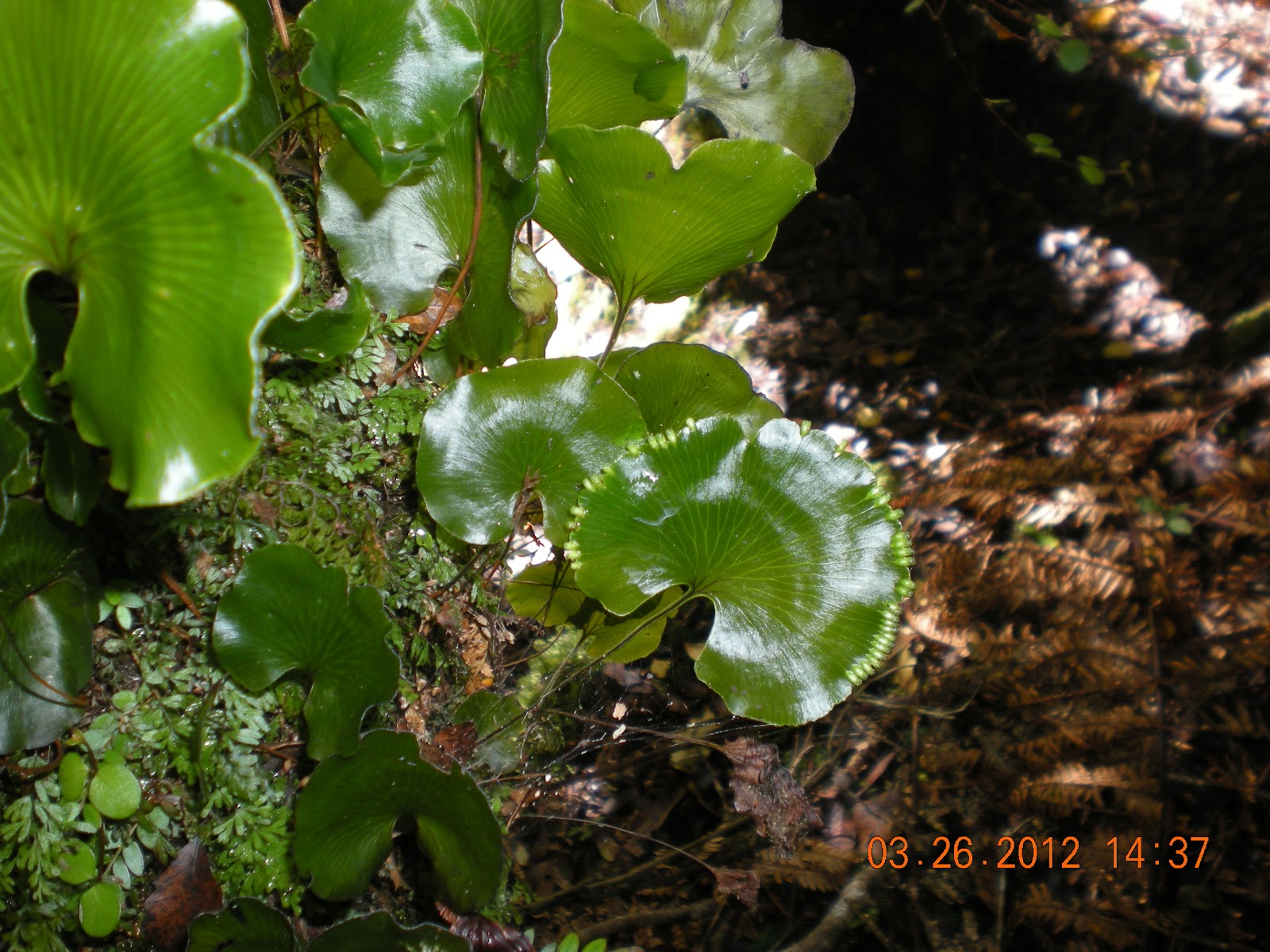
Trichomanes reniforms

Add caption
I just love finding new material and I had two great days on the track at the end of last week doing just that! It is so exciting when you pick up new ferns and then identify the rascals for collection and data. Takes me a while to do the second half of the job and identifying accurately does take precision and care....I'm getting quicker but still I can get stumped . the filmy ferns sometimes fail on the fertile fronds and therefore become difficult at best and really of no use. The northeren end of the Hemi is steep and I was on my bum for a lot of the descent...much easier to go up and the forest is quite different ...hence the different ferns. At last I have Polystichum- shield ferns ...a couple of species and also Ctenopteris and Pallaea...that is what I get excited about! Core curriculum days are coming up next week and I need to do my Leadership assignment...second one before we depart for the South Island on May 24...finding it hard to be inspired about that as i have been busy getting spreadsheet of fern data up to date and also the mounting process. In quiet moments I have also been working on a power point but long way off yet and not long to go....i really love the passion i have found when i come across a new plant!!
Took in the competition to school for naming our new kiwi at Nga Manu and it will hopefully be a tribute to the late Peter MacKenzie who died last week....he was the founding father and inspiration for Nga Manu...a true conservationist. Though I never met him he is one of the reasons I am so privelleged to have this opportunity to work in such a treasure as Nga Manu....thankyou Peter.

The founder of Waikanae's Nga Manu Nature Reserve, Peter McKenzie, has died, aged 59.
Mr McKenzie founded Nga Manu in 1974, preserving the last large remnant of lowland coastal swamp forest on the Kapiti Coast.
Over the years he developed the reserve and became heavily involved with many recovery programmes to boost threatened native species.
He was involved with the Tuatara Recovery Programme for more than 20 years with over 1000 tuatara going through Nga Manu over the years for translocation.
In the mid 70s he spearheaded captive kiwi breeding programmes, setting the standard for breeding kiwis in institutions. A lot of his methods are still used today.
Mr McKenzie was also involved in the blue duck and brown teal recovery programmes and established a recovery programme for native mistletoe.
His interest in wildlife photography saw him launch Nga Manu Images producing photos used in many conservation publications.
He captured a puriri moth hatching on camera, which is still available on You Tube. Nga Manu manager Bruce Benseman described Mr McKenzie as an all round good bloke with a passion for conservation.
"He inspired thousands of people to go down the conservation path with many pursuing careers in conservation,'' Mr Benseman said.- DOM POST KAY BLUNDELL

Tuesday, 17 April 2012

Polymerase Chain Reaction

Teachers' Domain: Polymerase Chain Reaction
 the lab
 the agarose gel ready for electrolysis
 the dye added


This was today"s task at Vic Uni....i really have to figure this out for my own villification! I think I get it but not so straight forward. Leon was working today with micro millilitres...tiny amounts ...one thirtieth solutions of our original DNA.

More than half Way- Central Plateau and DNA extraction


With Easter behind us I feel that my fellowship is going down a slope to the end! Oh no! We have had a couple of tramps up to Rotopounamu and to Taranaki Falls on the Central Plateau...more interesting ferns on the way. The Stichus...Umbrella ferns on the Taranaki Falls walk were great and so many T. reniforme on the ponamu lakeside walk. ....photos to come. Beautiful weather for walking and it was good to be out and about. I am now into the process of mounting ferns and will have my first attempts this week. We use wettable tape to attach the ferns to the acid free card and leave space for the label. They must be mounted as seen growing or as closely as possible.
the equipment


Umbrella ferns- Stichus cunninghamii
Gentiana bellidifolia -not a fern but very cool


So this week has been a real science focus. On Tuesday Leon and I made our way up,up,up to Victoria University Kirk building , floor 6 , to a chemistry lab where we began a procedure to extract DNA from some 11 samples to determine if they were what they said they were morphologically. 

 Leon heating a pipette to make a glass grinder to crush the dried leaf tissue
Collecting liquid nitrogen which freezes the material in order to crush it
 cooking for 45 minutes to further break down and increase surface area for DNA extraction
Adding detergent/ then chloroform and then removing the aqueous liquid ....the DNA precipitates out and with help from the centrifuge we get pure DNA     Teachers' Domain: DNA Extraction
See the teacher domain post video in my blog...it shows exactly what we did!

http://www.sumanasinc.com/webcontent/animations/content/pcr.html- this site explains the PCA reaction which we do tomorrow

http://learn.genetics.utah.edu/content/labs/extraction/howto/- this is a site which shows DNA extraction in a kitchen!

Teachers' Domain: DNA Extraction

Teachers' Domain: DNA Extraction

Thursday, 29 March 2012

Nga Manu days- card games and Tuatara

So this week has been all at Nga Manu with a short expedition to the Magaone track to photograph ferns and have a look at a patch of bush in our Kapiti Coast region but not coastal or swamp forest. Some excellent examples of kidney ferns and filmy ferns...my eye is becoming much more acclimatized.
Hymenophyllum spp from Magaone track (filmy fern)
On Monday the day began with  a talk to the wonderful volunteer guides at Nga Manu. I also went for a walk with Grace Suckling ...a very able bodied and able minded 90 year old who shared her knowledge of ferns at Nga Manu...thankyou Grace.The guides are an amazing group of volunteers who assist making Nga Manu such a fabulous reserve.
Was also interesting to hear the current Chairman of the trust speaking at the meeting and find out about what is happening in terms of the future for Nga Manu...roadways, entrances  etc.
T. reniforme


In the afternoon I went up to the Magaone track just to see the Kidney ferns (Trichomanes reniforme ) and was not disappointed...they are amazing.


Then on Tuesday we began to prepare the Tuatara enclosure for digging. All of the burrows were marked ...around about 40 to 50 burrows in the sand and all of the obstacles were removed and cleared.Also on Tuesday I managed to do some more data basing of the ferns so far collected and we readied the classroom for the influx of visitors on the Wednesday.Wednesday was the launch of the game "Cloak of Protection " developed by Jill Manning and 36 children arrived to play 4 round of the game in the Nga Manu classroom.33 of the children were from my school so I was teacher in charge for the session. They were wonderful and thoroughly enjoyed the games they played.... SO engrossed!


The children also saw the eels being fed and were able to enjoy a walk through the bush later in the morning... altogether a good day.


The real excitement however for this week was Thursday...the day the Tuatara would be dug , collected and made ready for transfer to Young Nicks head and Cape Kidnappers...two mainland sanctuaries taking 20 Tuatara each to the East Coast...once a place where Tuatara thrived.The first to arrive were a contingent from Ngati Koata and the Victoria Uni scientists ...Sue and Kristine.We needed to dig and catch 40 Tuatara and bleed 20 or so. The .2ml of blood would then go off to Otago Uni for investigation of stress hormones in the reptile ...we also weighed and measured every animal and the blood sampled animals also had temperatures taken.The 70 tuatara were hatched and incubated at Victoria University after the eggs were gathered from sanctuary islands. They were taken to Nga Manu when they were about a year old.
The range in temperature was between about 16- 17 degrees and they were quite cold to the touch plus slow breathers! The length measurements are taken from the mouth to the vent and the vent to tip and then a further measurement of the tail regrowth if there had been a break. The range in colours was quite remarkable probably according to where the animal had been in the burrow or up and out.Was a real privilege to be able to see and handle so many Tuatara in one hit...fantastic.
The official hui involved all of the receiving iwi and the of  course the donors of taonga ....Ngati Koata and the handing over was Friday morning early so the reptiles could get on the road in good time...a long journey  to the North.


Sue Kristine and I taking the data

Hi!

transport capsules

ready

designer Tuatara

on the way

Rhys Mills  with his babies!

I was a part of something very special and really appreciated the opportunity to be involved with digging, nursing the bled animals, data recording and the final packing...wonderful to see conservation in action and with people who are passionate about what they do and are doing.